Revenue Engine
Grounded AI for Sales: Why Your Revenue Context Matters More Than the Model
- AI
- Revenue Intelligence
- Knowledge
- MCP
- Revenue Architecture
Point a capable AI model at a sales problem and it will usually return something fluent. It may suggest sensible discovery questions, write a tidy follow-up email, or produce a plausible deal summary. The problem is not that the answer is obviously bad. The problem is that it sounds like it could have been written for almost any company.
The model knows how sales works in general. It does not automatically know how yourcompany wins: which customers you serve best, how you describe the problem, what evidence your team trusts, where your methodology is strict, what was promised in the deal, and whether the customer received that value after the contract was signed.
That distinction is becoming more important than model choice. In a recent 20VC conversation, Fireworks AI founder Lin Qiao argued that “every single company should own their own intelligence.” Her argument was about specialised intelligence and control. For a revenue team, the practical version is simpler: your model is replaceable; your accumulated revenue context is not.
This is the case for grounded AI for sales: AI that works from approved company knowledge, live revenue evidence, and visible provenance instead of relying on a generic model and a clever prompt.
Generic AI Gives You the Market-Average Answer
General-purpose models are trained to be broadly useful. That is their strength. They can explain common sales frameworks, recognise familiar objections, and generate competent language across thousands of industries. But broad competence is not the same as company judgement.
Every company has a set of choices that make its revenue motion distinct. Your ideal customer profile excludes buyers another vendor would pursue. Your positioning emphasises a problem a competitor treats as secondary. Your qualification process gives some evidence more weight than other evidence. Your brand voice reflects what you believe and what you refuse to say. Those choices are not noise around the model. They are the operating system for how your company sells.
Without that operating context, AI defaults to the average of what it has seen elsewhere. A deal review becomes a generic MEDDPIC checklist. A follow-up email becomes polished filler. A forecast narrative repeats the CRM fields without explaining what changed. The output may be technically correct and still be commercially useless.
Better Prompting Breaks at Team Scale
The first response is often to write a better prompt. Add the positioning. Paste the ICP. Explain the tone. Include the methodology. Remind the model not to overstate the evidence. This can improve one output, but it creates a new operational problem.
Important company knowledge becomes scattered across personal prompt libraries, chat histories, enablement documents, onboarding notes, and the memories of experienced managers. Two people ask the same question and receive answers grounded in different versions of the truth. A new pricing rule is approved, but an old prompt still contains the previous one. A brand message changes, but nobody knows which automated workflows need updating.
Prompt engineering is useful. It is not a substitute for knowledge architecture. At team scale, the question is not “How do we write the perfect instruction?” It is “How do we give every approved AI workflow the right context, at the right version, with a record of what it used?”
MCP Is Plumbing. Context Gives the Plumbing Meaning.
The Model Context Protocol is an open standard for connecting AI applications to data sources, tools, and workflows. The protocol matters because it gives AI clients a consistent way to reach external systems. It is already moving into sales software: Microsoft documents a Dynamics 365 Sales MCP server that can retrieve sales data, generate insights, draft emails, and expose opportunity-specific tools.
That is meaningful infrastructure. But access does not create judgement. An AI agent can retrieve an opportunity record and still misunderstand why the deal matters. It can access a folder of documents and still choose an obsolete battlecard. It can call a CRM tool and still produce a recommendation that ignores how your company qualifies risk.
This is why the strongest way to think about MCP is as plumbing. Plumbing moves something useful to where it is needed. It does not decide whether the water is clean, which source is approved, or what should happen when two sources disagree. The durable asset is the governed context flowing through it.
What Grounded Revenue Context Actually Contains
A conventional AI knowledge base usually starts with documents. Grounded revenue context needs to go further. It combines stable company knowledge with the changing evidence produced by the revenue lifecycle.
Approved company knowledge
Positioning, ICP definitions, product claims, pricing rules, security posture, brand voice, methodologies, battlecards, case studies, and reactive plays should be structured as governed assets. The AI should know which material is draft, which is under review, and which is approved for use.
Live revenue state
Context also includes what is happening now: the opportunity stage, stakeholder coverage, activity gaps, qualification evidence, risk signals, forecast changes, and the next commitment. This is the difference between reciting the company playbook and applying it to a real decision.
Longitudinal customer evidence
The richest context does not stop at Closed Won. It connects what the buyer said, what the seller promised, what onboarding delivered, whether value was evidenced, and what should happen at renewal or expansion. A company’s real intelligence is built across that history. It is not contained in a single call transcript or CRM field.
Governance Comes Before Generation
Grounding is not simply attaching more text to a prompt. More context can create more confusion if the system cannot distinguish approved truth from work in progress. A useful grounding layer needs a publication boundary, version history, and provenance.
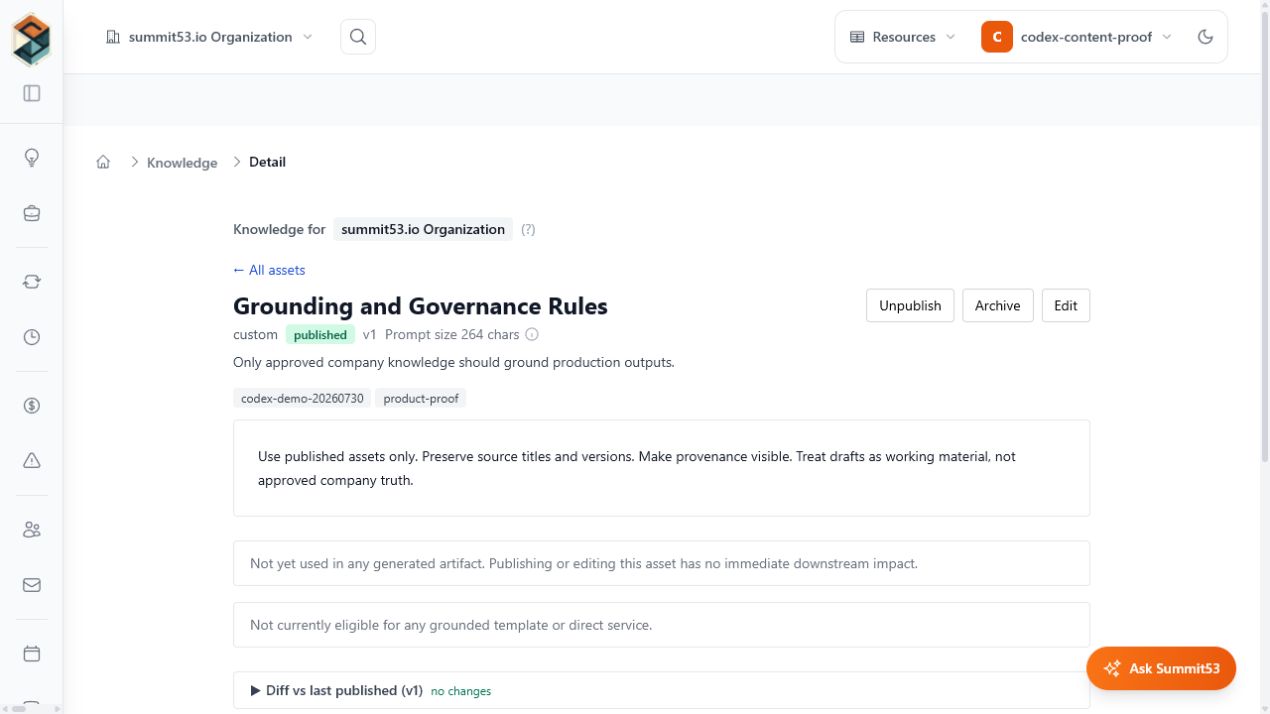
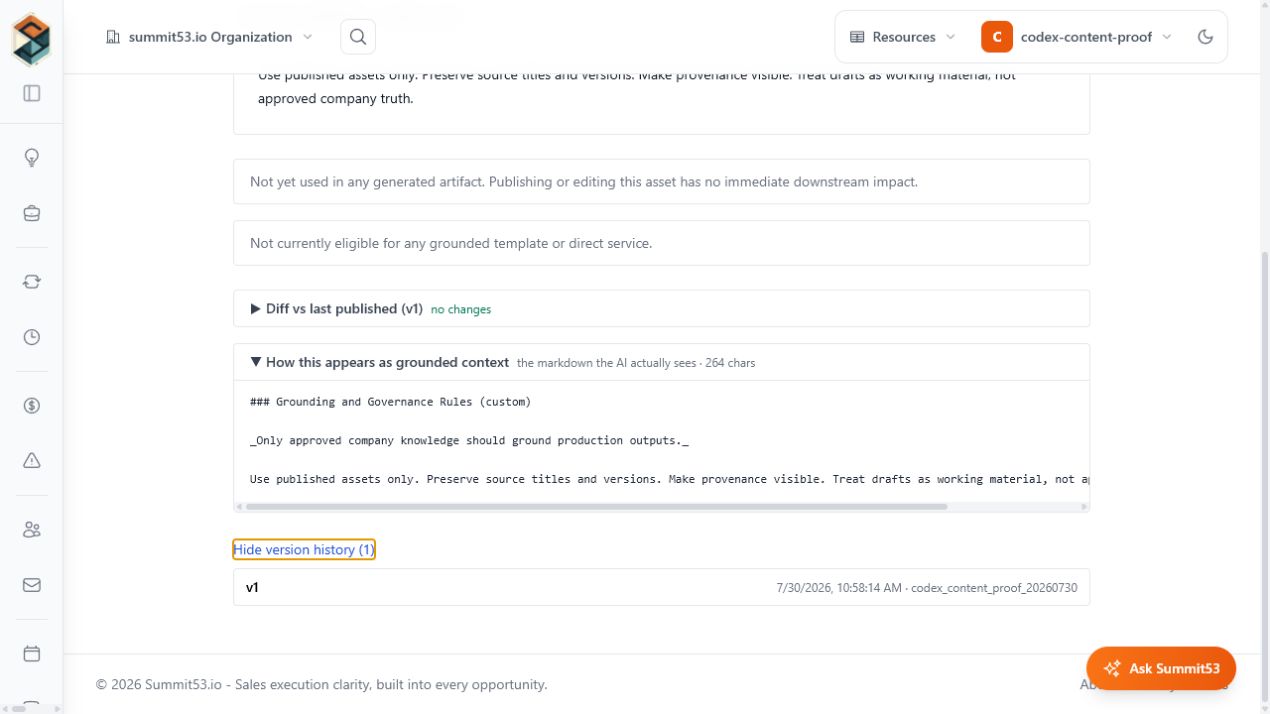
In Summit53, Knowledge assets are organisation-scoped and versioned. Grounded generation uses published assets, not drafts. Teams can preview the exact markdown supplied to the model, including its prompt size, before that context reaches a workflow. Published versions create a stable reference point, so a generated artefact can retain the source version it used even after the underlying asset changes.
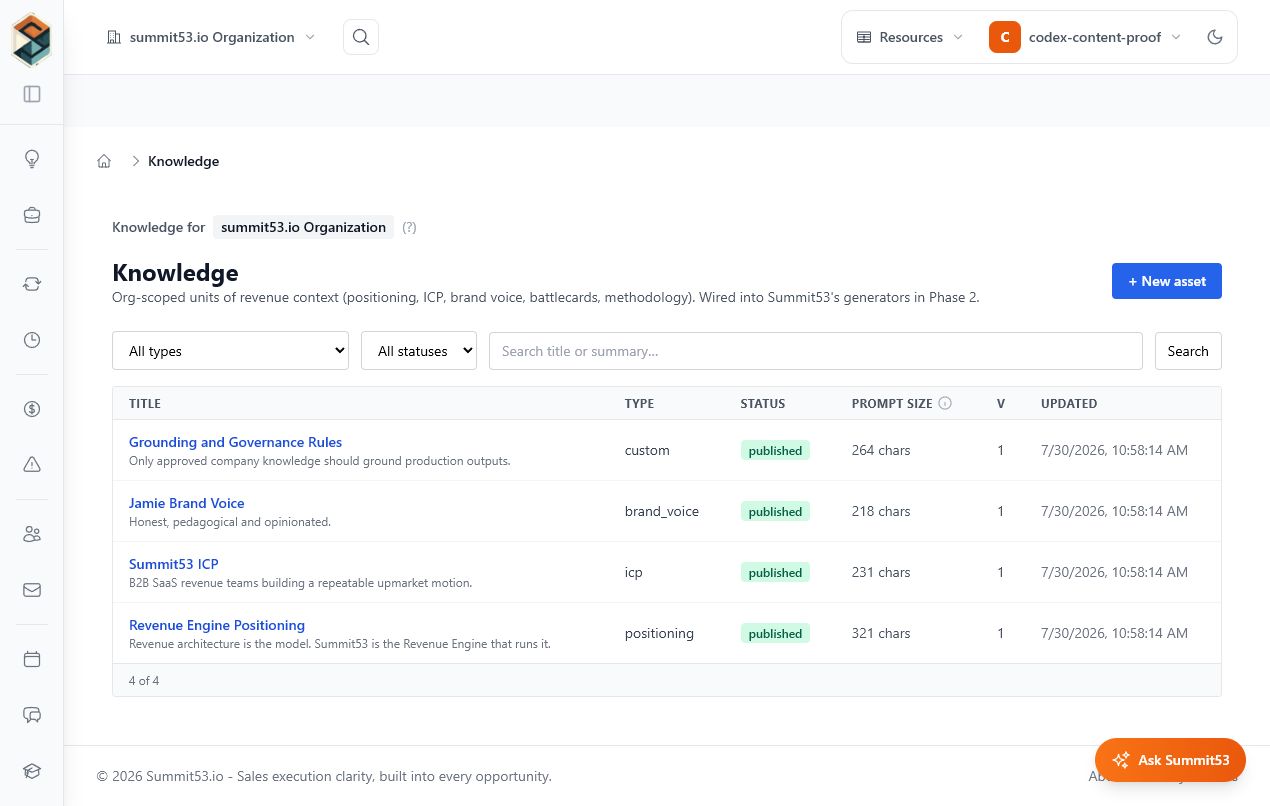
This changes the trust conversation. A revenue leader does not have to accept that “the AI said so.” They can inspect the company knowledge behind the output, see the version that was used, and determine whether the evidence is still current. Governance becomes part of the intelligence rather than an approval process bolted on afterwards.
Grounded Context Belongs Inside the Revenue Engine
Knowledge becomes more valuable when it is applied to the full revenue motion. Summit53’s Revenue Engine uses a Figure-Eight model: acquisition and pipeline execution on one side; delivery, value, expansion, and renewal on the other. The loop matters because each side improves the other.
A case study should not be treated as a static marketing document. It is evidence from delivery that can improve future qualification and discovery. An implementation delay is not only a customer-success issue. It may reveal a promise that sales needs to frame differently. A renewal outcome should inform which ICP signals matter and which value claims hold up in practice.
When governed knowledge is combined with live revenue state, AI can work from the same operating context as the leadership team. It can identify a methodology gap using the company’s definition, draft an outreach message in the approved voice, and relate a deal promise to post-sale evidence. That is more useful than giving each department a separate AI assistant with a separate memory.
The Model Will Change. Your Context Should Remain.
Model performance is improving quickly, prices are moving, and the best choice for a workflow will continue to change. A team may prefer one model for deep analysis, another for high-volume drafting, and a specialised model for a sensitive or regulated task. Building your company’s intelligence inside a single model provider makes every future choice harder.
Customer-owned context creates a more durable architecture. The company retains the knowledge assets, live revenue history, evaluation criteria, and provenance. Models can be selected or replaced at the workflow layer. MCP can reduce the cost of connecting that context to different AI clients, although true portability still depends on sensible data contracts, permissions, and governance.
The moat is not today’s generated answer. It is the accumulated context that makes tomorrow’s answer better: the decisions your team approved, the patterns it observed, the commitments it made, and the outcomes it measured.
A Practical Starting Point for Revenue Teams
You do not need to build a perfect knowledge graph before grounding useful workflows. Start with one recurring decision where generic AI output is visibly weak.
- Name the decision. Choose a deal review, follow-up, forecast narrative, coaching plan, or account brief that the team produces repeatedly.
- Identify the stable knowledge. List the positioning, ICP, methodology, product, and voice guidance that should influence the output.
- Create an approval boundary. Separate drafts from published company truth and assign an owner to each asset.
- Connect live evidence. Add the opportunity, account, activity, stakeholder, and lifecycle signals needed to apply the knowledge to the current situation.
- Preserve provenance. Record which assets and versions grounded each output.
- Evaluate the result. Measure whether the grounded workflow improves the decision, not simply whether the writing sounds better.
The goal is not to make AI imitate your company’s vocabulary. It is to help AI reason from your company’s approved judgement and current evidence.
Own the Context That Makes the Model Useful
AI models will become more capable and more interchangeable. Access protocols will make it easier to connect them to business systems. Neither trend removes the need for company-specific intelligence. It makes that intelligence more valuable.
Your AI should know how your company wins — and whether customers received what was promised. That requires more than a model and more than plumbing. It requires a governed revenue context that your company owns.
That is the layer Summit53 is building into the Revenue Engine: approved knowledge, live revenue evidence, and lifecycle context that can travel with the business even when the model changes.