Operationalising Sales Frameworks (MEDDPIC, BANT, SPICED): From Theory to Daily Execution
Sales frameworks work when they move from a checklist to a habit. The gap most teams face isn’t knowing MEDDPIC, BANT, or SPICED — it’s operationalising them in the flow of work, across every opportunity, without adding admin or feeling like policing.
Summit53’s Framework Service helps teams put these methodologies into motion. It turns conversations and notes into structured evidence, highlights what’s missing, and recommends context-aware next steps — so deals progress with clarity and confidence.
Why Operationalising Frameworks Improves Outcomes
- Fewer slipped deals: Missing Decision Process, Budget, or Timeline risks surface early, not at quarter-end.
- Better forecast accuracy: Health and lifecycle signals reflect real evidence — not just field hygiene.
- Scalable coaching: Reps get stage-appropriate prompts; managers see patterns without micromanaging.
- Consistent language: A common framework reduces ambiguity between AEs, managers, RevOps, and leadership.
How Summit53 Operationalises MEDDPIC, BANT, and SPICED
Under the hood, the Framework Service analyses opportunity activity to extract framework components, score quality, and attach defensible evidence — all with performance-focused architecture (caching, bulk ops, and intelligent threading). These insights feed both rep workflows and leadership views.
- Automatic extraction: Pulls MEDDPIC/BANT/SPICED signals from meeting transcripts and notes.
- Evidence + scoring: Every score links to real snippets (e.g., “Economic Buyer named: Dana, CFO”).
- Deal health + lifecycle: Summaries indicate completeness and momentum — not just data presence.
- Risk detection: Flags gaps such as no Decision Criteria, no Champion, or vague Budget authority.
- Action generation: Suggests follow-up questions and next steps aligned to stage and risk.
Curious how this shows up for reps? See our short overview: AI-Driven Sales Execution with MEDDPIC and AI Meeting Prep for Sales.
Practical, Stage-Based Examples
Below are common scenarios where operationalising frameworks with Summit53 helps move deals forward — without turning methodology into a box-ticking exercise.
1) Early Discovery — BANT as a Clarity Engine
Scenario: You’ve had a strong first meeting. There’s clear interest, but Budget and Authority are ambiguous. Timeline is “this quarter if possible.”
- What Summit53 surfaces: Budget not validated; Authority unclear; Need is articulated but not quantified; Timeline vague.
- Suggested actions: “Confirm budget range and approval path; ask who signs; validate timing drivers (e.g., renewal, project deadline).”
- Outcome: AEs leave discovery with concrete next steps and better signal on deal viability — before time gets sunk.
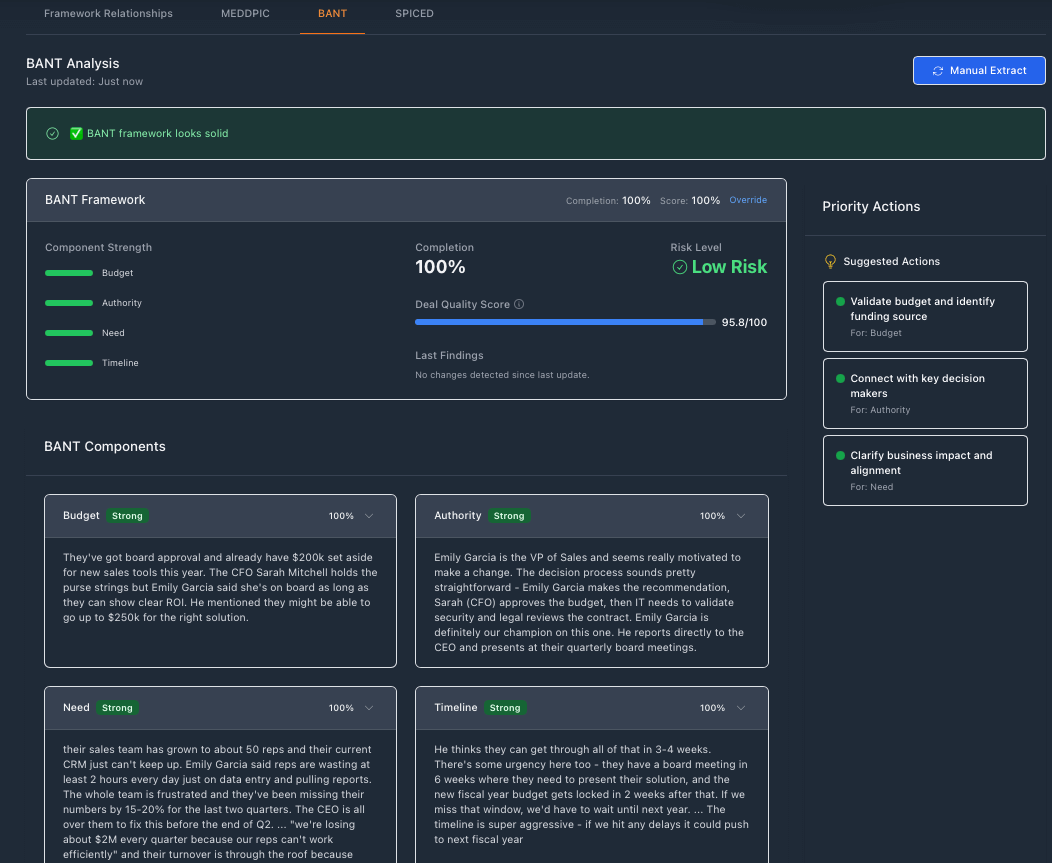
Example: BANT operationalised with component strength, deal quality score, and suggested actions.
2) Mid-Evaluation — MEDDPIC to De-Risk Execution
Scenario: Product evaluation is active. You have technical buy-in but Decision Criteria aren’t explicit; the Economic Buyer hasn’t been engaged; Metrics are qualitative.
- What Summit53 surfaces: Gaps across Metrics, Economic Buyer, and Decision Criteria with supporting evidence from notes and emails.
- Suggested actions: “Co-create success criteria and win plan; secure EB meeting; quantify impact (e.g., hours saved, risk reduced).”
- Outcome: The deal isn’t just “progressing” — it’s anchored to a shared definition of value and approval.
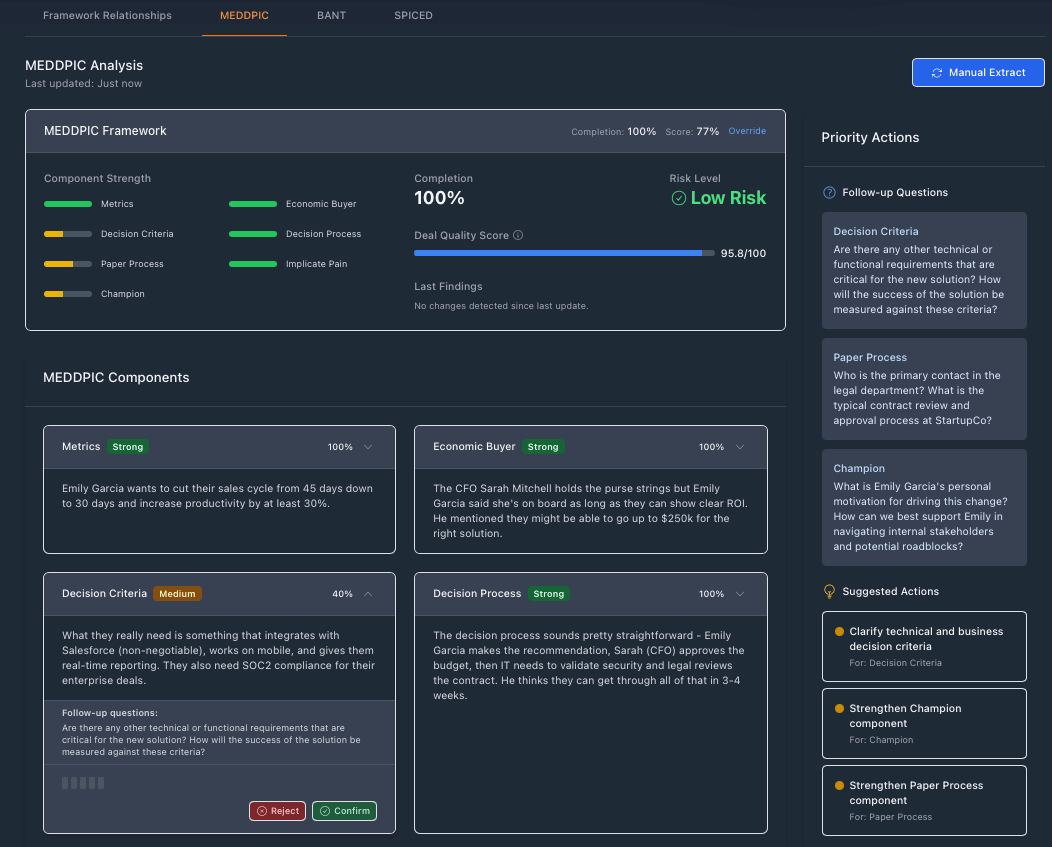
Example: MEDDPIC with evidence-backed components, follow-up questions, and risk-aware next steps.
3) Late-Stage / End of Quarter — MEDDPIC + BANT for Commit Discipline
Scenario: Deal is in commit for this quarter, but there’s no confirmed line-of-sight to procurement and legal timelines. Champion is supportive; EB touch is indirect.
- What Summit53 surfaces: Decision Process is incomplete; Budget confirmed but buyer authority not directly engaged; legal/procurement not scheduled.
- Suggested actions: “Lock critical path: confirm EB meeting, align contract terms, secure legal/procurement slots, publish a backwards plan from quarter-end.”
- Outcome: Leaders get a realistic commit; reps get a concrete closing plan — reducing EOQ surprise slips.
4) Expansion/Renewal — SPICED to Re-Anchor Value
Scenario: Renewal is coming up. Usage is healthy, but the executive sponsor changed and the original Pain/Impact isn’t top-of-mind.
- What Summit53 surfaces: Situation and Impact statements are outdated; Critical Event unclear; Decision path changed.
- Suggested actions: “Reconfirm value drivers and metrics; align to the new sponsor’s priorities; tie renewal to a critical date; reset Decision path.”
- Outcome: Renewal conversations shift from usage to business value — strengthening price and expansion.
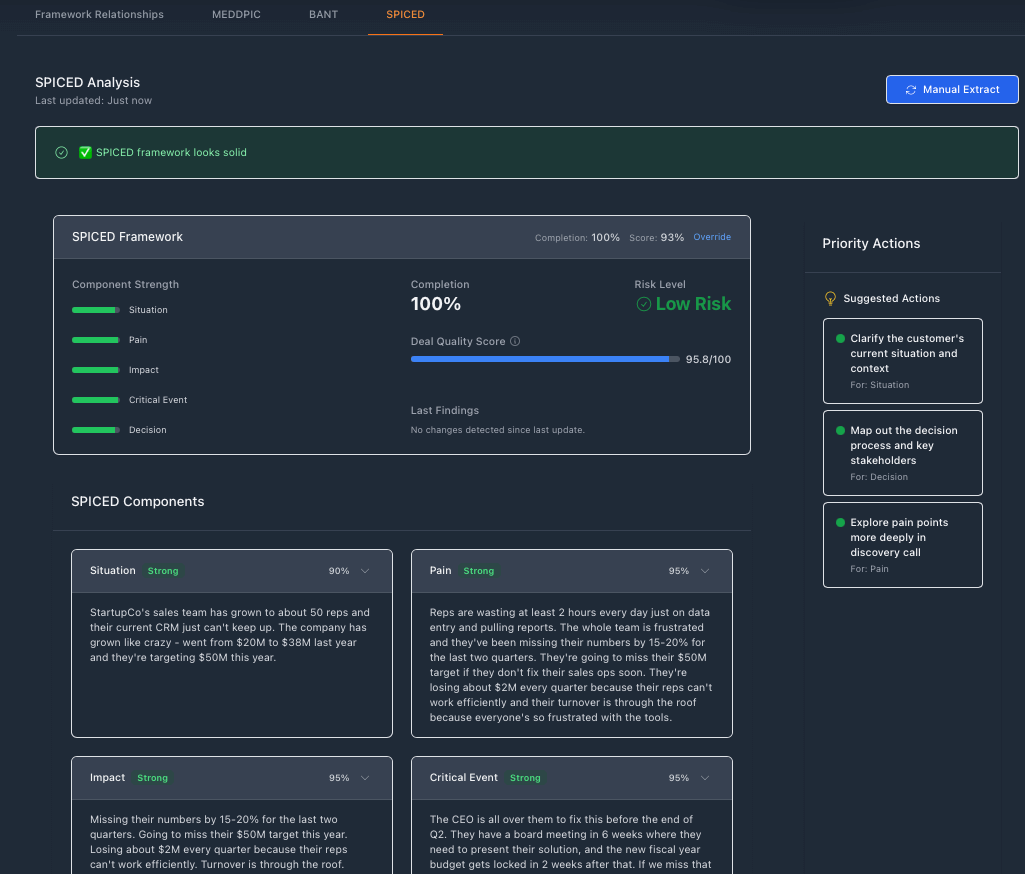
Example: SPICED view highlighting Situation, Pain, Impact, Critical Event, and Decision.
Coaching Without Policing
Summit53 is designed to enable better outcomes — not to audit reps. We avoid the "are you following best practices?" vibe by focusing on assistive execution:
- Evidence over enforcement: Scores are backed by quotes and context; reps can add/override when they learn more.
- Stage-appropriate prompts: Nudges align with where the deal actually is, not a generic checklist.
- Lightweight by design: Insights come from the work you already do — meetings and notes — not extra fields.
From Insight to Action: Where It Shows Up
- Weekly Action Plans: A prioritized list of next steps per rep based on framework gaps and deal risk.
- Pipeline Intelligence: A real-time view of framework completeness, risk levels, and deal health across the funnel.
- Opportunity Views: Clear summaries of MEDDPIC/BANT/SPICED components with evidence and suggested follow-ups.
Enterprise-Ready Under the Hood
The Framework Service is built for speed and reliability: caching for fast summaries, intelligent threading for note processing, and bulk database operations for scale. It integrates via RESTful APIs and plugs into frontend components like Framework Overview Cards and Deal Intelligence dashboards.
How notes and transcripts are captured: reps can use Intelligent Meeting Capture or add structured notes directly — no email connection required.
Getting Started
- Pick your core framework focus by stage (e.g., BANT in discovery, MEDDPIC in evaluation/late, SPICED for renewals/expansion).
- Connect meeting notes and call transcripts (where available); let extraction run on your existing pipeline.
- Use Weekly Action Plans in 1:1s to drive clarity and momentum.
- Review Pipeline Intelligence weekly to align on risk and remove blockers early.
If you’d like to see how your pipeline looks through the lens of operationalised frameworks — and how assistive automation can remove friction for your team — get in touch.