The BANT Qualification Framework: A Modern Guide for B2B Sales Teams
BANT has been qualifying deals since the 1950s, when IBM first codified the four criteria every sales conversation should cover: Budget, Authority, Need, and Timeline. Seven decades later, it remains one of the most widely adopted qualification frameworks in B2B sales, and for good reason. It works.
But "works" comes with a caveat. The buying landscape BANT was built for barely resembles today's reality. Buying committees now average six to ten decision-makers. 96% of prospects research independently before engaging sales. And 86% of B2B purchases stall at some point in the cycle. Teams that treat BANT as a first-call checklist are leaving deals on the table. Teams that treat it as a living qualification lens, evolving across the deal cycle, consistently outperform.
This guide covers how BANT actually works in practice, where it falls short, and how modern sales teams are adapting it to qualify faster and close more reliably.
What BANT Actually Measures
Each letter in BANT represents a qualification dimension. But the depth of each dimension matters far more than whether you've ticked the box.
Budget
The classic question is "do they have budget?" The better question is "can they build the business case to justify this investment?" In 2026, with CFOs demanding tighter justification for every technology purchase, qualifying budget means understanding whether the value your solution delivers outweighs the proposed cost, not just whether a line item exists in a spreadsheet.
Strong budget qualification sounds like: "They've allocated $150K for sales tooling this year, and their VP of Sales has discretionary authority up to $200K." Weak qualification sounds like: "They said budget isn't an issue."
Authority
Authority used to mean finding the one person who signs. In a world of consensus-driven buying, authority means mapping the decision network: who influences, who evaluates, who approves, and who can kill the deal. Research from Gartner consistently shows that deals with a single point of contact are significantly more likely to stall or lose to no-decision.
Need
Need is where many reps confuse interest with urgency. A qualified need isn't just "they like what we do." It's a problem the organisation feels compelled to address now, with consequences for inaction. The distinction matters because interest doesn't create urgency, and without urgency, deals slip.
Timeline
Timeline qualification should answer two questions: when do they need to decide, and what's driving that date? A timeline anchored to a real event (contract renewal, board review, compliance deadline) is far stronger than "sometime this quarter." Without an external driver, your deal is competing against inertia, and inertia usually wins.
Where BANT Falls Short
BANT's critics have legitimate points, and understanding them makes the framework more useful, not less.
The checkbox problem: Too many teams turn BANT into an interrogation. Reps ask "what's your budget?" on the first call and wonder why prospects disengage. The framework was designed as a lens for understanding, not a script for questioning. When BANT becomes robotic, it creates the exact friction it was meant to reduce.
Buying complexity: BANT doesn't explicitly map the decision process, competition, or the paper trail (legal, procurement, security reviews) that derails enterprise deals. For transactions under $25K with a single decision-maker, that's fine. For six-figure enterprise deals with multiple stakeholders, you need more structure.
Seller-centric framing: BANT's questions are fundamentally about whether the buyer is ready for the seller. Modern buyers, who complete much of their journey before talking to sales, respond better to frameworks that start with their situation and pain rather than your qualifying criteria.
None of this means BANT is dead. It means BANT is a foundation, not a ceiling. The smartest teams use it accordingly.
Modern BANT: How High-Performing Teams Adapt It
Companies that implemented BANT effectively saw a 59% increase in conversion rates, according to InsideSales research. Those using BANT with a clearly defined ICP report up to 38% higher win rates. The key word is "effectively", which means going beyond the acronym.
Treat Qualification as Continuous, Not Binary
Modern BANT implementation acknowledges that qualification is a spectrum. A deal isn't simply "BANT qualified" or "not". Each dimension has depth, and that depth changes as the deal progresses. Budget might be unclear on the first call but confirmed by the third. Authority might start with a champion and expand to an economic buyer over time.
The practical implication: don't disqualify too early, and don't stop qualifying just because you checked the boxes once. Revisit BANT criteria at every stage transition.
Score, Don't Just Check
A binary yes/no for each BANT criterion tells you very little. A scoring model that rates each dimension on a scale (backed by evidence) gives reps and managers a shared language for qualification strength. "Budget: 7/10, confirmed allocation, pending final approval" is infinitely more useful than "Budget: yes."
Layer with Deeper Frameworks
The highest-performing teams use BANT as an initial filter, then layer in deeper frameworks as deal complexity increases. A common pattern: SDRs use BANT for initial qualification and routing, then AEs apply MEDDPIC or SPICED for evaluation and negotiation stages.
This isn't framework bloat. It's matching qualification depth to deal complexity. BANT answers "should we spend time on this?" MEDDPIC answers "how do we win it?" SPICED answers "do we understand their world well enough to earn the right?"
Rehumanise the Conversation
The best BANT practitioners never say the words "budget, authority, need, or timeline" in a discovery call. Instead, they weave qualification into natural conversation. Instead of "what's your budget?", they ask "how have you typically funded projects like this?" Instead of "who's the decision-maker?", they ask "who else would need to be comfortable with this for it to move forward?"
BANT vs. Other Frameworks: When to Use What
Framework selection isn't about finding the "best" one. It's about matching the right framework to your deal complexity and sales motion.
BANT is ideal for high-volume, transactional sales with shorter cycles, deals under $25K, and SDR teams that need fast, repeatable screening. It's also the right starting point when you need to quickly separate tyre-kickers from genuine opportunities.
MEDDPIC/MEDDPICC is built for complex enterprise deals with multiple stakeholders, long cycles, and high contract values. It adds Metrics, Decision Criteria, Decision Process, Identify Pain, Champion, and (optionally) Competition and Paper Process. If your average deal takes six months and involves a procurement team, MEDDPIC is your framework.
SPICED (Situation, Pain, Impact, Critical Event, Decision) is customer-centric and works well for SaaS teams focused on discovery-driven selling and building business cases collaboratively with buyers. It's particularly strong for expansion and renewal motions where you need to re-anchor value.
Many teams run a hybrid: BANT for initial screening, SPICED for discovery, and MEDDPIC for mid-to-late-stage deal management. The frameworks aren't competitors. They're layers.
Operationalising BANT with Summit53
Knowing the theory is step one. Getting it into the daily flow of deal execution is where most teams stall. Reps know they should qualify rigorously, but when you're running twenty deals, admin always loses to activity.
Summit53's Framework Service automates the operational layer. Inside any opportunity, the Tactical tab provides a dedicated BANT Analysis view that extracts signals from meeting transcripts and notes, scores each dimension with evidence, and surfaces gaps before they become risks.
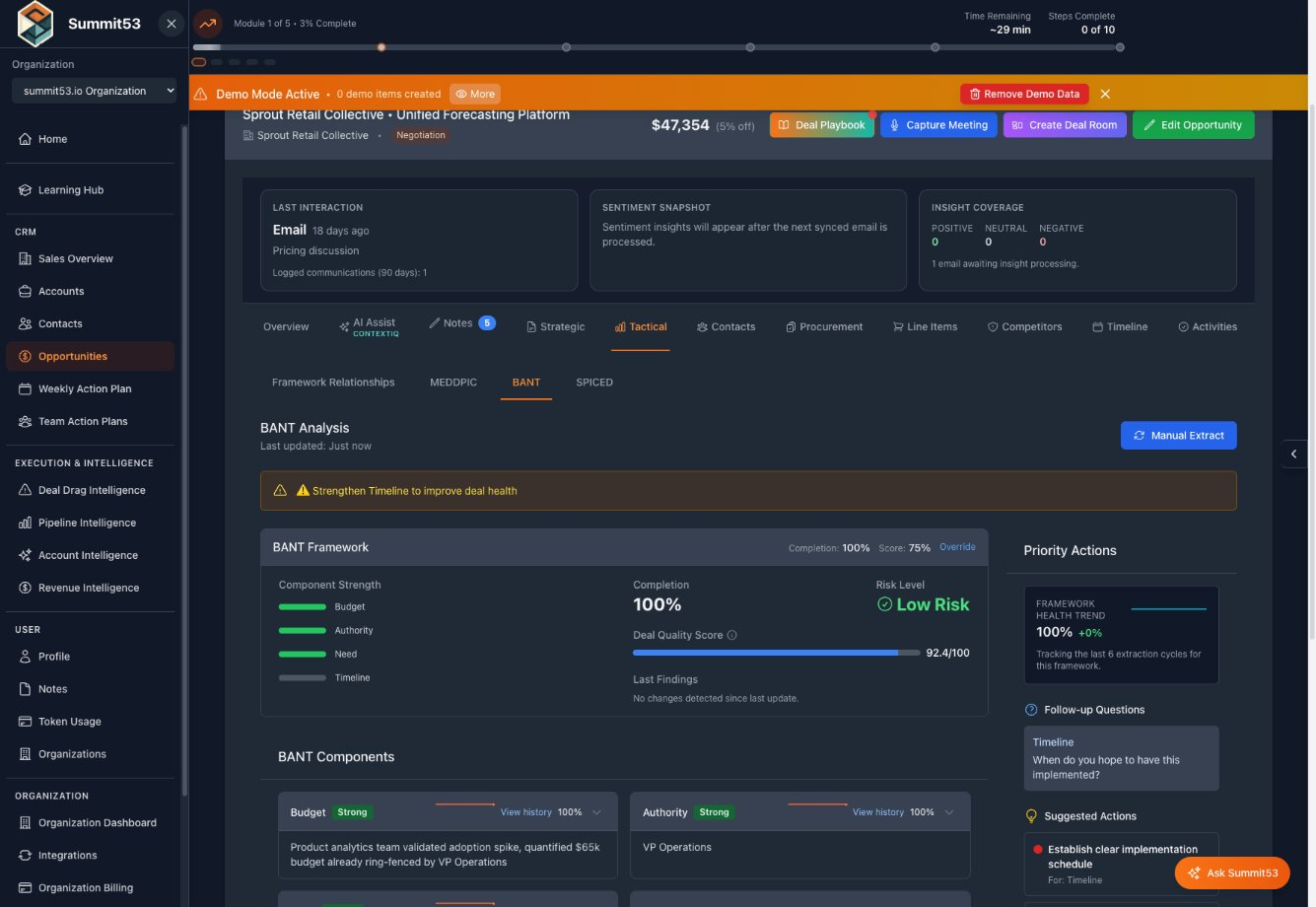
The BANT Tactical view inside an opportunity: component strength bars, evidence-backed scoring, risk level, and AI-generated priority actions.
Here's what you see at a glance: a BANT Framework card showing Completion, Score, and Risk Level for the deal, alongside component strength bars for Budget, Authority, Need, and Timeline. Each bar is colour-coded: green for strong evidence, grey for missing. The Deal Quality Score (out of 100) and a Framework Health Trend chart track how qualification is evolving over time, not just where it stands today.
Below the summary, individual component cards show the extracted evidence. For example, Budget might read "Product analytics team validated adoption spike, quantified $65k budget already ring-fenced by VP Operations" with a Strong badge and a 100% score. Timeline might show "Missing" at 0% with no evidence found. This isn't a rep's self-assessment. It's what the AI actually found in their notes and transcripts.
On the right, the Priority Actions sidebar drives the coaching conversation. Follow-up Questions are specific to the weak components ("When do you hope to have this implemented?" for Timeline). Suggested Actions are prioritised and colour-coded: red for urgent gaps like "Establish clear implementation schedule", green for reinforcement like "Connect with key decision makers." A manager reviewing this deal in a pipeline call can instantly see what needs attention and what's solid.
Summit53 also supports layering frameworks. The Tactical tab sits alongside MEDDPIC and SPICED views for the same deal, and a Framework Relationships view shows where the frameworks align or conflict. As a deal moves from early discovery (BANT) into evaluation (MEDDPIC) and expansion (SPICED), the system adapts. Read more about how this works across the full deal lifecycle in our guide to operationalising sales frameworks.
Putting This Into Practice
Whether you're implementing BANT for the first time or modernising an existing process, here's a practical starting point:
- Build a scoring rubric, not a checklist. Define what a 3/10, 5/10, and 8/10 looks like for each BANT dimension. Anchor scores to observable evidence (quotes, documents, confirmed stakeholders), not assumptions.
- Qualify at every stage, not just the first call. BANT criteria change as deals progress. Budget gets firmer, authority maps expand, timelines shift. Update your qualification at each stage transition.
- Match framework depth to deal complexity. Use BANT for initial screening and simpler deals. Layer in MEDDPIC for enterprise. Don't force a complex framework on a transactional motion.
- Automate the admin. Qualification insights should come from the work reps already do (calls, emails, notes), not extra fields they need to fill out. Technology that extracts qualification signals automatically gets better data and higher adoption.
- Use qualification in coaching, not policing. The goal is better outcomes, not compliance theatre. Frame BANT gaps as coaching opportunities, not audit findings.
67% of lost sales stem from reps not properly qualifying leads before pursuit. That's a staggering waste of time and pipeline. BANT won't solve every qualification challenge, but applied with depth and discipline, it remains one of the most effective tools for separating real opportunities from wishful thinking.
If you'd like to see how BANT qualification looks when it's operationalised across your pipeline, with real evidence, scoring, and coaching insights, get in touch.