Why Your Green Framework Scores Are Lying to You — Framework Alignment and the Hidden Gap in Deal Qualification
Here is a scenario most sales leaders will recognise. Your rep updates a deal in the CRM. BANT looks solid — budget confirmed, authority mapped, need validated, timeline agreed. MEDDPIC is tracking well too — champion identified, economic buyer engaged, metrics quantified. The forecast call goes smoothly. Everyone feels good about the quarter.
Then the deal slips. Or worse, it dies quietly in legal review. The post-mortem reveals something nobody caught: BANT said the timeline was locked for Q2, but MEDDPIC had no paper process evidence at all. The champion was enthusiastic, but SPICED showed zero critical event urgency. Each framework told a green story individually. Together, they were screaming orange.
This is the problem with how most teams use qualification frameworks today. They score each framework in isolation, then wonder why their forecast accuracy sits stubbornly around 40-60%. The missing piece is not a better framework — it is what happens between them.
The Framework Isolation Problem
Most B2B sales organisations have adopted at least one qualification framework. Many use two or three — BANT for initial screening, MEDDPIC for deeper qualification, SPICED for customer-centric discovery. This is sensible. Each framework was designed to answer different questions about a deal, and together they provide far more coverage than any single methodology.
But here is where it breaks down. In practice, these frameworks live in separate fields, separate tabs, or separate spreadsheets. A rep fills out BANT during discovery, updates MEDDPIC after a demo, and perhaps adds SPICED notes after a deeper conversation. Nobody asks the obvious question: do they agree with each other?
Consider what each framework is actually measuring. BANT focuses on commercial readiness — can they buy, and will they buy soon? MEDDPIC maps the decision machinery — who decides, how they decide, and what evidence exists? SPICED examines the buyer’s world — what is broken, how bad is it, and what forces a decision? These are different lenses on the same deal, and when they contradict each other, something is wrong.
Yet almost no team systematically checks for those contradictions. We call this framework alignment — the degree to which your qualification frameworks tell a consistent story about a deal. And when alignment is low, it is one of the most reliable leading indicators that a deal is at risk.
What Framework Alignment Actually Means
Framework alignment is not about whether each framework scores well. It is about whether the evidence across frameworks supports the same conclusion. A deal can have high individual framework scores and low alignment — and that combination is more dangerous than a deal with consistently mediocre scores, because the inconsistency is invisible unless you look for it.
Think of it like a medical check-up. Your blood pressure might be perfect, your cholesterol normal, your resting heart rate excellent. But if your blood pressure says you are relaxed while your cortisol says you are stressed, that contradiction tells a story the individual numbers do not. The same principle applies to deal qualification.
Alignment works by examining the relationships between framework components that should logically agree. For example:
- MEDDPIC Pain and SPICED Impact: If MEDDPIC says pain is well-quantified but SPICED shows no business impact, one of those assessments is wrong. Pain without impact means the problem is real but nobody has connected it to revenue, cost, or risk — which means no urgency to act.
- BANT Timeline and MEDDPIC Paper Process: If BANT says the deal closes in six weeks but MEDDPIC shows zero evidence of procurement engagement, that timeline is a wish, not a plan. Legal review, security questionnaires, and contract negotiation do not materialise from thin air.
- MEDDPIC Champion and SPICED Critical Event: If you have a strong internal champion but no external forcing function, the champion is carrying the entire deal on enthusiasm alone. That works until their attention shifts to the next fire drill.
- BANT Authority and MEDDPIC Decision Process: If BANT says authority is confirmed but MEDDPIC shows no mapped decision process, you probably have a single enthusiastic contact whothinks they can sign off. With buying committees averaging 10-11 stakeholders in 2026, that is a dangerous assumption.
Each of these is a cross-framework relationship — a pair of components from different frameworks that should tell the same story. When they diverge, you have a misalignment, and misalignments have a habit of becoming deal-killers at the worst possible moment.
Three Misalignment Patterns That Kill Deals
After analysing hundreds of B2B deals, three misalignment patterns show up repeatedly. Recognising them early gives your team a genuine coaching advantage.
Pattern 1: The Timeline Fantasy
This is the most common. BANT shows a committed close date. The rep has even asked the prospect directly: “When are you looking to have this in place?” and received a confident answer. But when you check MEDDPIC, Paper Process is empty or vague. No procurement contact identified, no legal review scheduled, no security questionnaire submitted.
The misalignment here is between commercial intent and operational readiness. The prospect may genuinely want to close in Q2. But wanting to close and being able to close are different things. Sales cycles have stretched by over 20% in recent years as buying committees grow, and the procurement leg of the journey is where most slippage actually happens. This pattern is easy to spot if you compare BANT Timeline against MEDDPIC Paper Process — and almost invisible if you only look at each framework independently.
Pattern 2: The Enthusiasm Gap
Your champion is engaged, responsive, and telling you all the right things. MEDDPIC shows a strong Champion score. But SPICED reveals no Critical Event — no regulatory deadline, no board mandate, no competitive threat forcing a decision. Meanwhile, BANT Need is strong, but SPICED Situation shows no recent trigger event.
This pattern produces deals that feel great in the pipeline but never quite close. The champion is excited about solving the problem, but the organisation has no structural reason to act now. Without a forcing function, even the most enthusiastic champion gets deprioritised when budget season arrives or leadership attention shifts. The misalignment between internal enthusiasm (MEDDPIC Champion) and external urgency (SPICED Critical Event) is your early warning system.
Pattern 3: The Value Disconnect
MEDDPIC Metrics says you have quantified the value — the prospect agrees they will save $200k annually. But SPICED Impact shows the customer has not connected that saving to any strategic priority. And BANT Budget shows the money is ringfenced but has no executive sponsor linking it to a business outcome.
The value disconnect means your ROI story lives in a spreadsheet, not in the buyer’s strategic narrative. When the CFO asks “why this, why now?” nobody in the buying committee can answer in terms the C-suite cares about. Deals with this pattern often stall at the proposal stage — the business case is technically sound but emotionally flat.
How to Measure Alignment (Without More Spreadsheets)
The good news is that framework alignment can be measured systematically once you know what to look for. Here is a practical approach any team can start with, even before investing in tooling.
First, map your cross-framework relationships. Take each component from your primary frameworks and identify which components in other frameworks should logically agree. For a team using MEDDPIC, BANT, and SPICED, you will typically find 10-15 meaningful relationships. Not every component pair matters — focus on the ones where disagreement signals real risk.
Second, categorise each relationship by severity. Not all misalignments are equal. A disconnect between BANT Timeline and MEDDPIC Paper Process is critical — it directly threatens your close date. A gap between MEDDPIC Metrics and SPICED Impact is a mismatch — it weakens your business case but may not kill the deal immediately. A developing relationship is one where the gap is closing over time. And healthy means the frameworks agree.
Third, review alignment during deal reviews, not just framework scores. The most impactful change you can make is adding one question to your weekly pipeline review: “Which framework components disagree on this deal, and what does that tell us?” This single question transforms a forecast review from a number-checking exercise into a genuine coaching conversation.
Fourth, track alignment trends over time. A deal where alignment is worsening — where frameworks are diverging rather than converging — is a deal that is becoming riskier regardless of what the individual scores say. Conversely, a deal where alignment is improving, even if individual scores are still moderate, is a deal that is solidifying.
What This Looks Like in Practice
We built framework alignment directly into Summit53 because we kept seeing the same pattern: teams running multiple frameworks diligently, scoring each one carefully, and still missing the gaps between them. The goal was to make alignment visible without adding any manual work for reps.
When you open an opportunity in Summit53 and navigate to the Tactical tab, you will find a Framework Relationships view alongside the individual MEDDPIC, BANT, and SPICED sub-tabs. This view calculates a deal alignment score automatically by comparing every cross-framework relationship and flagging contradictions.
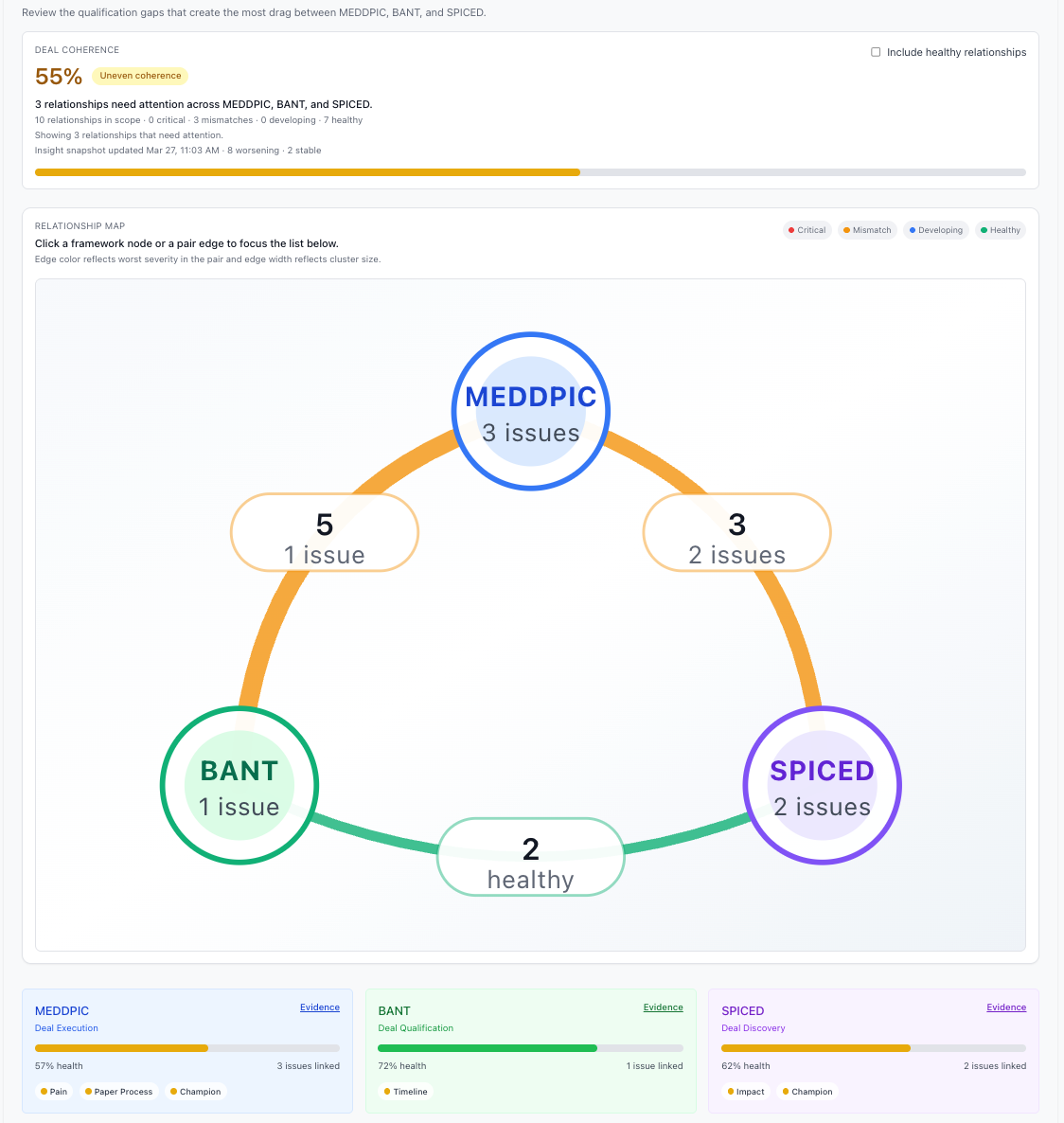
The Framework Relationships map visualises cross-framework alignment at a glance. Orange edges indicate misalignments that need attention — in this case, three relationships across MEDDPIC, BANT, and SPICED are telling different stories about the same deal.
The relationship map gives you the shape of the problem in seconds. Each node represents a framework, sized by the number of issues found. The edges between them are colour-coded: red for critical contradictions, orange for mismatches, yellow for developing relationships, and green for healthy alignment. You can filter by severity or by category — Value Chain, Decision Making, Urgency, or Internal Dynamics — to focus on the type of risk that matters most for a given deal stage.
Below the map, individual mismatch cards show the specific contradiction: which components disagree, by how much, and whether the gap is worsening or improving. Each card includes AI-generated insight explaining what the mismatch means for the deal and a recommended action to resolve it.
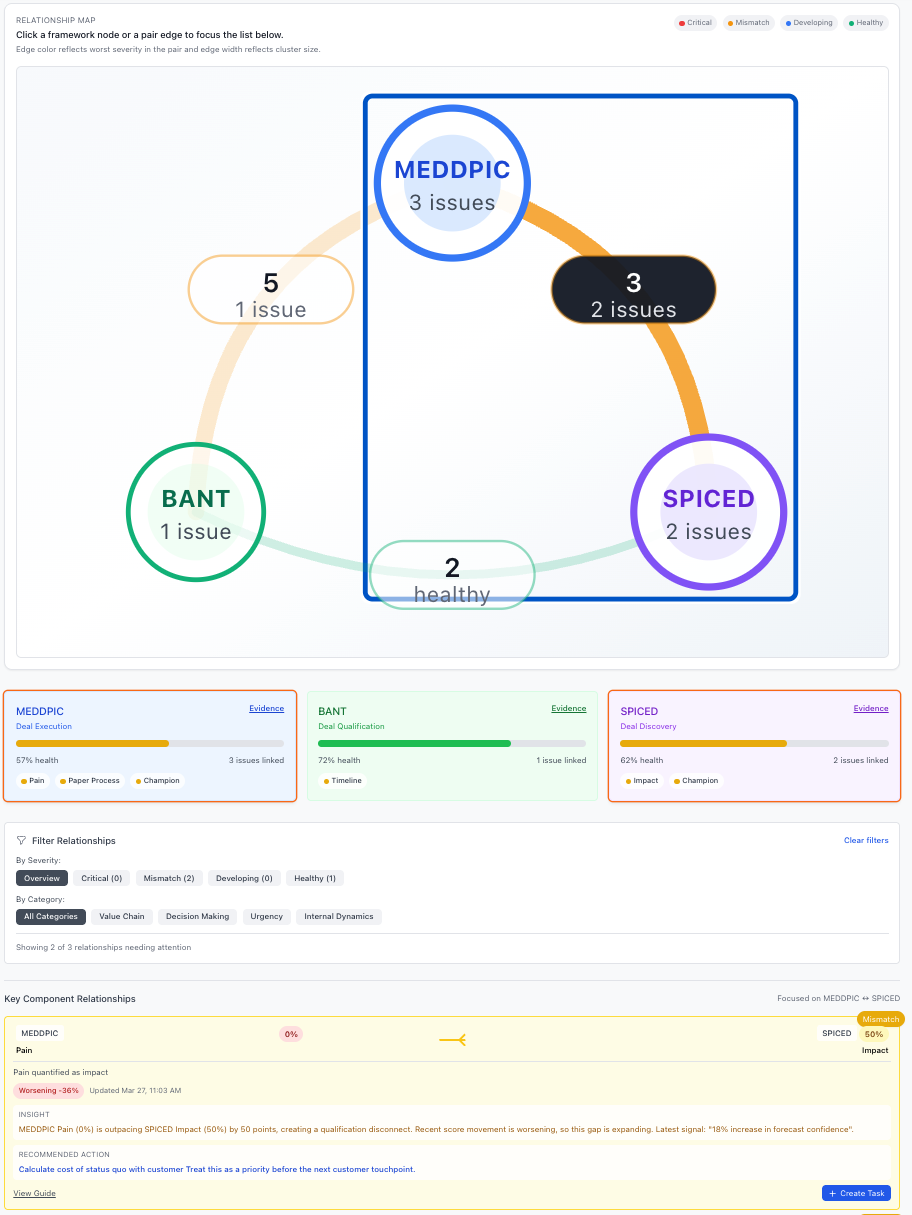
Each mismatch card surfaces the specific contradiction — here, MEDDPIC Pain scores 0% while SPICED Impact shows 50%. The worsening trend and recommended action turn a hidden risk into a coachable moment.
What makes this genuinely useful for coaching is the connection to the individual framework views. Click through to the MEDDPIC Tactical tab and you will see every component scored with evidence extracted automatically from call transcripts and notes. The Priority Actions sidebar generates specific follow-up questions for each weak component — questions like “What legal or procurement steps are required to complete this deal?” for a missing Paper Process. These are not generic prompts; they are generated from the actual deal context.
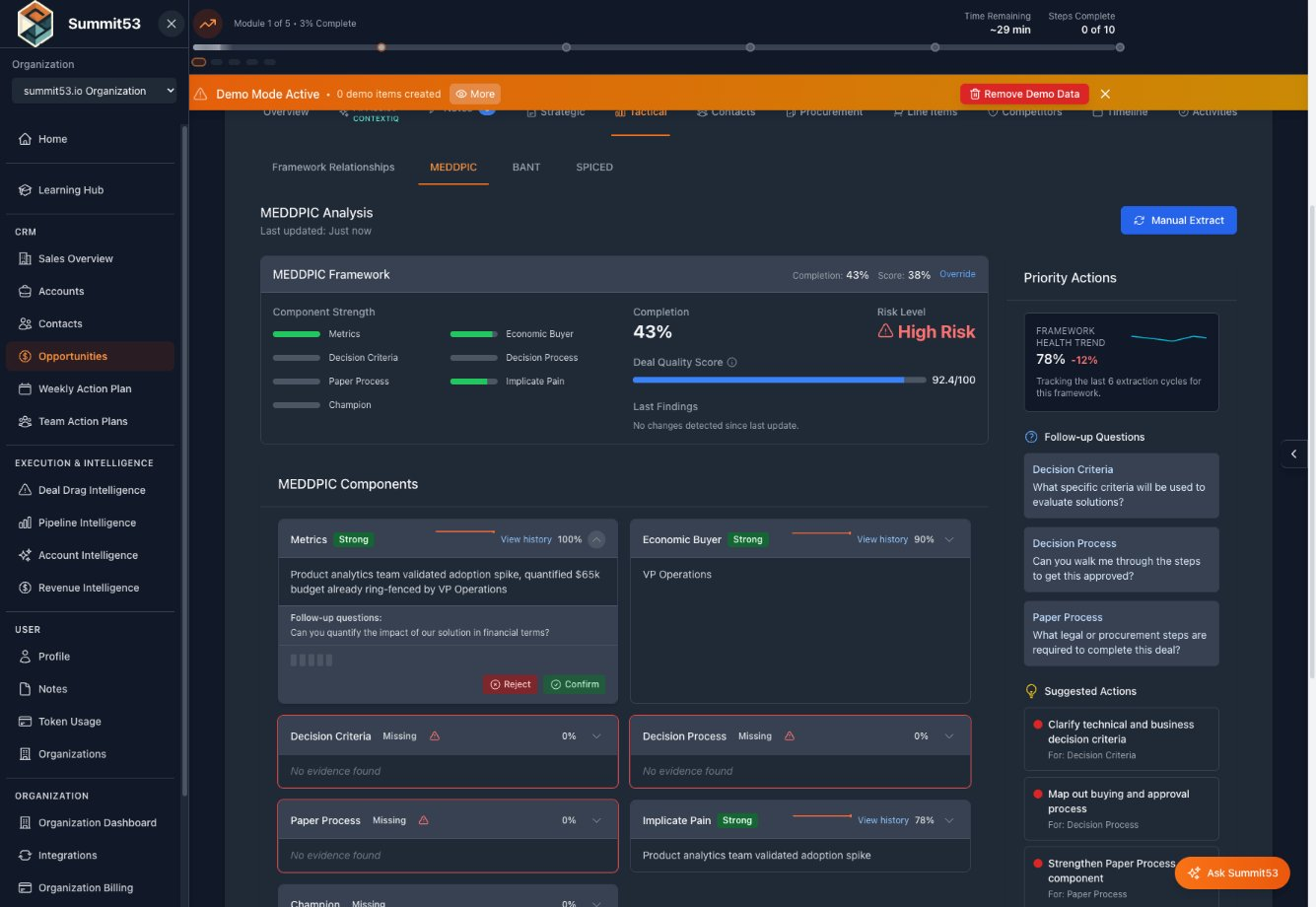
The MEDDPIC Tactical view with Priority Actions sidebar. The Framework Health Trend tracks improvement over time, while AI-generated follow-up questions turn framework gaps into specific coaching conversations.
The key insight is that alignment issues become coaching actions automatically. A manager does not need to manually cross-reference three frameworks in a spreadsheet before a 1:1 — the alignment view surfaces the contradiction, and the framework view provides the specific question to ask. This is the difference between knowing a deal has risk and knowing exactly what to do about it.
For a quick look at how this flow works in practice, we put together a two-minute walkthrough showing framework alignment in action on a live deal — from the relationship map through to the coaching questions.
From Scoring to Coaching: Why Alignment Changes the Conversation
The real value of framework alignment is not the score itself — it is how it changes the quality of sales coaching. Most pipeline reviews today follow a predictable pattern: the rep recites stage, close date, and deal value; the manager asks whether the champion is engaged; someone adjusts the forecast. These conversations stay at the surface because the data stays at the surface.
Alignment shifts the conversation from “is this deal on track?” to “what is this deal telling us?” When a manager can see that BANT says close in six weeks but MEDDPIC has no procurement evidence, the coaching question writes itself: “Have we actually talked to legal yet?” When MEDDPIC shows a strong champion but SPICED shows no critical event, the question becomes: “What happens if they decide to do nothing this quarter?”
These are the conversations that actually move deals forward. And they are nearly impossible to have consistently without visibility into cross-framework alignment, because the contradictions are invisible when you look at each framework on its own.
For teams already using multiple frameworks operationally, alignment is the natural next step. You have already invested in the methodology. The question is whether your tools are helping you see the full picture — or only showing you each framework in its own silo.
Getting Started
You do not need to overhaul your sales process to start thinking about framework alignment. Here are three things you can do this week:
- Pick your top three deals and cross-check manually. For each deal, ask: does BANT Timeline match MEDDPIC Paper Process? Does MEDDPIC Champion have a SPICED Critical Event backing them up? Does BANT Budget connect to SPICED Impact? Five minutes per deal will likely surface at least one surprise.
- Add one alignment question to your next deal review. Try: “Which framework components disagree on this deal?” It is one question, but it changes the entire dynamic of the conversation from reporting to coaching.
- Track which misalignment pattern appears most often. If most of your slipped deals have the Timeline Fantasy pattern (Timeline strong, Paper Process empty), that tells you something specific about where your team needs coaching — and it is far more actionable than generic “improve forecast accuracy” initiatives.
If you would like to see how Summit53 automates framework alignment across MEDDPIC, BANT, and SPICED — including the relationship map, mismatch detection, and coaching actions — we would love to show you. Get in touch and we will walk through it on your own pipeline data.